Dry eye is a multifactorial disease, which means that multiple underlying causes often contribute to the same set of symptoms. When a patient has tried several treatments without adequate relief, it is almost always worth asking: is there something we haven't addressed yet?
For a significant percentage of dry eye patients, the answer is Demodex — a genus of microscopic mites that live in the hair follicles of the eyelashes. At Toluca Lake Optometric Center in Burbank, CA, assessing for Demodex blepharitis is a standard part of our dry eye evaluation — because missing it means treating the wrong thing.
What Is Demodex?
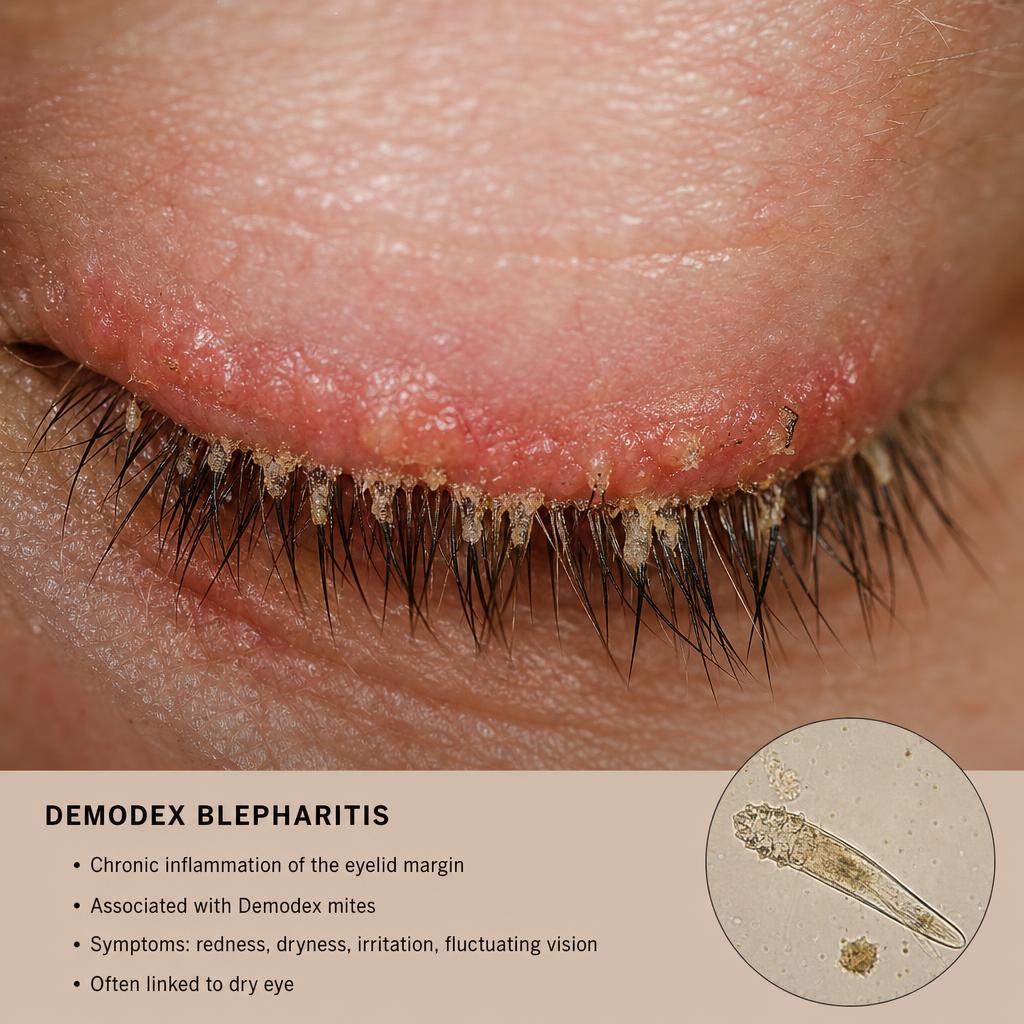
Demodex mites are tiny, microscopic organisms — typically 0.1 to 0.4mm long — that live in the sebaceous follicles of the skin. Two species affect humans: Demodex folliculorum, which tends to colonize the hair follicle shaft, and Demodex brevis, which lives deeper in the sebaceous glands.
Nearly everyone carries some Demodex. Under normal circumstances, the immune system keeps their population in check and they cause no symptoms. The problem arises when the population becomes elevated — a condition called demodicosis — at which point the mites begin triggering an inflammatory response in the eyelid tissue.
Demodex blepharitis is now recognized as one of the most common causes of eyelid inflammation, affecting a substantial portion of patients who present with chronic blepharitis, dry eye, and eyelash abnormalities.
What Makes Demodex Blepharitis Distinctive
Demodex-related blepharitis has several features that distinguish it from other forms of lid disease:
Cylindrical dandruff (collarettes). The most specific clinical sign of Demodex blepharitis is the presence of waxy, cylindrical deposits clustered at the base of the eyelashes. These are the mites' waste products and egg casings, and they are visible on slit-lamp examination. When a clinician sees collarettes, Demodex is almost certainly involved.
Anterior lid inflammation. Unlike meibomian gland dysfunction, which primarily involves the posterior lid margin, Demodex blepharitis often causes inflammation at the anterior margin — along the lash line itself.
Itching. Demodex blepharitis frequently causes significant eyelid itching — a symptom that is less typical of pure MGD or aqueous-deficient dry eye.
Recurrent styes. The mites' presence in and around the gland openings increases the risk of blocked meibomian glands and recurrent chalazia.
How Demodex Worsens Dry Eye
Demodex blepharitis doesn't just irritate the eyelids — it directly impairs the mechanisms that keep the ocular surface healthy:
Disrupting meibomian gland function. The mites colonize the gland openings and the follicles immediately adjacent to them. Their mechanical obstruction, combined with the inflammatory response they trigger, impairs meibomian gland secretion. Reduced oil quality and quantity in the tear film leads directly to evaporative dry eye.
Elevating lid inflammation. The mites themselves are inflammatory stimuli, and their waste products further amplify the inflammatory response. Chronic lid inflammation from Demodex feeds the same inflammation cycle that drives meibomian gland dysfunction.
Disrupting tear film stability. A compromised eyelid margin — with collarettes around the lashes, inflamed tissue, and impaired gland function — creates an unstable environment for tear film production and distribution with each blink.
Standard Treatments That Don't Help Demodex
This is critical: conventional dry eye treatments do not kill Demodex mites. Artificial tears, warm compresses, omega-3 supplements, and standard antibiotic lid wipes have no meaningful effect on the mite population. If Demodex is a significant contributor to a patient's lid disease and dry eye, these treatments will provide only partial, temporary relief.
IPL has been shown to reduce Demodex populations as a secondary effect of its photothermal action, which is one reason IPL patients often experience improvement in lid disease that goes beyond what the vascular effects alone would explain. But targeted Demodex treatment is now available and provides more direct control.
Treating Demodex Blepharitis
The most effective targeted treatment for Demodex is lotilaner ophthalmic solution 0.25% (XDEMVY), which received FDA approval as the first prescription medication specifically indicated for Demodex blepharitis. Applied twice daily for six weeks, it directly kills both Demodex species and clears collarettes.
In-office treatment with hypochlorous acid-based cleansers, tea tree oil preparations (which contain terpinen-4-ol, active against Demodex), and thorough eyelid debridement is also part of management. Long-term maintenance — proper eyelid hygiene, avoiding eye makeup that can harbor mites, and regular follow-up — helps keep the population controlled.
Getting Tested for Demodex in Burbank
If you have chronic dry eye, recurring eyelid irritation, itching along the lash line, or frequent styes, it is worth asking whether Demodex has been assessed. At Toluca Lake Optometric Center, we evaluate for Demodex as part of our comprehensive dry eye workup using slit-lamp examination looking for the characteristic collarettes.
Call us at (818) 841-1212 to schedule a dry eye evaluation in Burbank, CA.