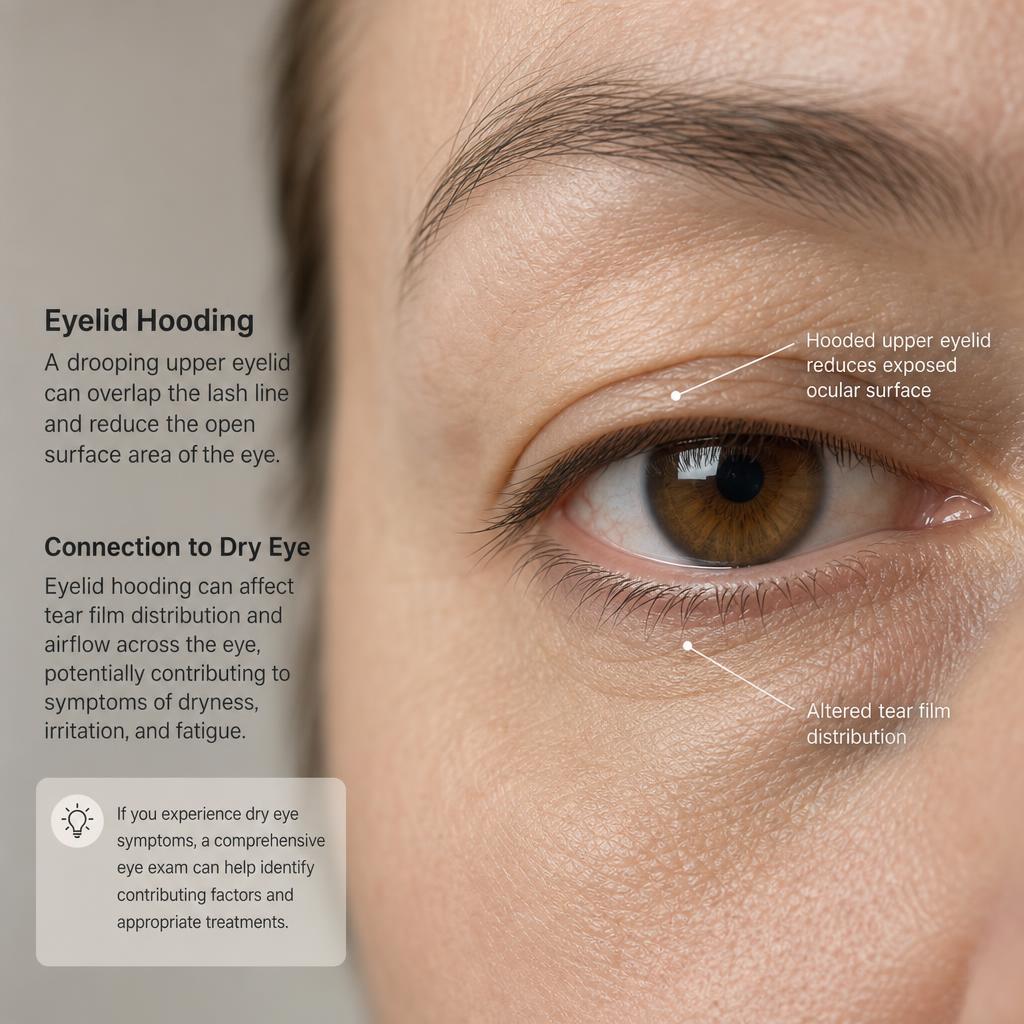
Eyelid hooding — the gradual descent of skin over the upper eyelid, sometimes to the point of partially obscuring the eye — is widely understood as an aesthetic concern. People want to address it because it makes them look tired, older, and more heavy-lidded. What is far less discussed is that eyelid position and lid skin laxity have direct functional consequences for the health of the ocular surface.
At Toluca Lake Optometric Center in Burbank, CA, we approach eyelid rejuvenation from both a medical and aesthetic perspective — and the connection between lid anatomy and dry eye is one of the most important things we help patients understand.
How Blinking Keeps Your Eyes Healthy
A normal, complete blink does several things simultaneously:
Distributes the tear film. The upper lid sweeps across the corneal surface with each blink, spreading a fresh layer of tears evenly from limbus to limbus. Without a complete blink, portions of the cornea are inadequately covered.
Activates the meibomian glands. The mechanical action of the eyelid closing compresses the meibomian glands and expresses a fresh pulse of oil into the tear film. Incomplete blinking means less oil expressed per blink — reduced oil in the tear film, faster evaporation, and drier eyes.
Clears debris and refreshes the surface. The blink action also clears accumulated debris and waste products from the tear film, maintaining a clean ocular surface between blinks.
In a healthy eye, a complete blink happens 15 to 20 times per minute. Most people are unaware that during focused visual tasks — reading, screen use, driving — blink rate drops significantly, and blink completeness decreases. The upper lid may not fully close with each blink, leaving the lower portion of the cornea incompletely covered. This is called incomplete blinking or lagophthalmos, and it is a known driver of evaporative dry eye.
How Eyelid Hooding Affects Blink Mechanics
When excess skin descends over the upper eyelid, it creates additional weight and drag that the lid-lifting muscles must overcome with each blink. Over time, this increased resistance tends to result in:
Reduced blink excursion. The lid may not descend as far as it should with each blink, leaving the lower corneal surface uncovered and oil expression incomplete.
Increased effort to blink. The orbicularis oculi muscle has to work harder to close the eye against the resistance of excess skin. This contributes to eye fatigue.
Altered lid position at rest. In more advanced cases, excess skin physically weighs down the upper lid in a way that keeps the eye slightly open at the lid margin level — a form of mild lagophthalmos that leads to evaporative dryness of the exposed inferior cornea.
Chronic lid rubbing. Patients with significant hooding sometimes unconsciously rub or lift their eyelids throughout the day, which contributes to lid margin inflammation and meibomian gland disruption.
None of these effects happen in isolation — they compound. A patient with significant hooding may have reduced meibomian gland oil expression per blink, incomplete tear film distribution, and chronic inferior corneal exposure — all simultaneously. The result can be a meaningful contribution to dry eye symptoms.
Addressing Both the Anatomy and the Disease
At Toluca Lake Optometric Center, we think about eyelid hooding from both directions: what can we do about the lid position, and what do we need to do for the dry eye itself?
For the lid position:
Non-surgical options — TriLift, TempSure Envi, and Altius RF — can improve the tone and firmness of the upper eyelid skin for patients with mild to moderate hooding. These treatments tighten the lid skin, reduce laxity, and improve the structural support of the upper lid without surgery or downtime.
For patients with more significant excess skin — particularly when it is obstructing vision — surgical upper blepharoplasty is the definitive treatment. In those cases, we coordinate with ophthalmologists and plastic surgeons as appropriate.
For the dry eye:
Regardless of what is done about the eyelid position, the dry eye disease typically requires its own treatment: meibomian gland assessment with infrared meibography, IPL if meibomian gland dysfunction and inflammation are present, lid disease management, and in some cases, work on blink completeness through behavioral approaches and lubricating drops strategically placed to support incomplete blinkers.
Why This Matters for Both Aesthetics and Eye Health
The aesthetic and medical motivations for addressing eyelid hooding reinforce each other. Patients who pursue treatment for cosmetic reasons often find that their eyes are more comfortable afterward. Patients who come in for dry eye care are sometimes surprised to learn that their lid anatomy is contributing to their symptoms.
At Toluca Lake Optometric Center, the fact that we care about both the appearance and the function of the eyelids is what makes our approach different from either a purely cosmetic or purely clinical setting.
If you are bothered by eyelid hooding — whether cosmetically, functionally, or both — call us at (818) 841-1212 to schedule a consultation at our Burbank office.